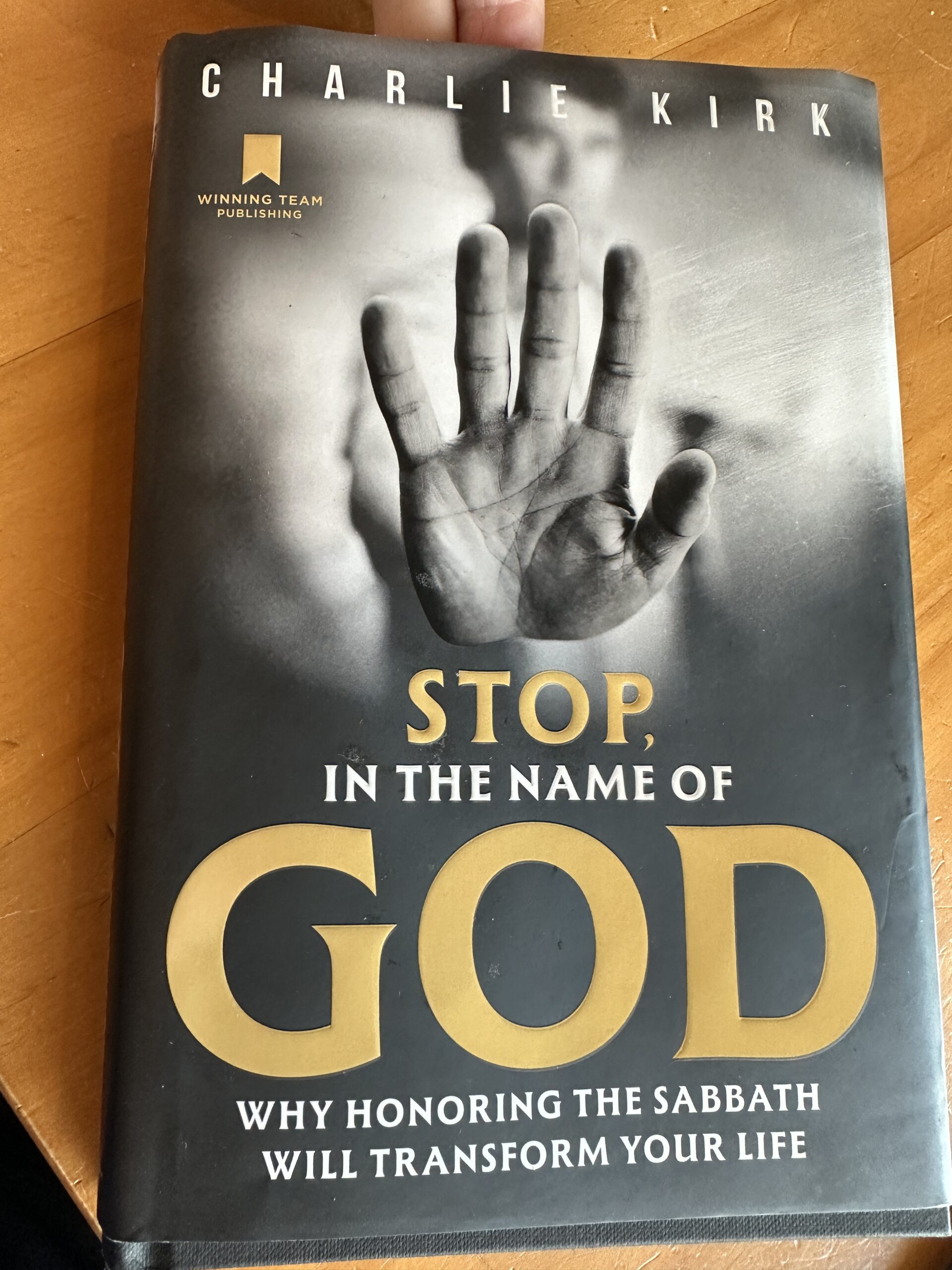
That’s the name of a new book written by one of the busiest men in America. It’s about the ancient practice and biblical command to observe the Sabbath. The ancient Hebrew word, Shabbat, which translated into English as Sabbath means literally, “stop” (your labor, and rest).
Has it ever occurred to you that the Sabbath was first observed by God Himself, at creation? He rested Himself after six days of creating, not because He was tired, but because He was finished. He then blessed the Sabbath, the seventh day, a mystical act that held some importance to all humans who would inhabit His earth.
This was millennia before the Law was given to Moses on Mount Sinai, and that additional-Mt Sinai-insight into the Sabbath was given millennia ago. This mystical Sabbath celebration is ancient and enduring. Why do you think we might be so blind to it? Is it possibly important to our lives today? Might observing it be a lens to finding our way out of spiritual darkness in our day and culture?
Have you ever wondered why Christians pause for worship and rest on Sunday instead of Saturday? Have you ever wondered why Sabbath is so important and central to Judaism and the Jewish people? Its ancient and constant practice prompted one famous Jewish thinker, Ahad Ha’am, to say: “More than Jews have kept Shabbat, Shabbat has kept the Jews.”
Have you ever wondered or read what the early church fathers said about the Sabbath? Men like Ignatius and Augustine? Or more recent church fathers like Luther, Calvin, Wesley, and Pink?
I have some wonderful news. All those questions and more are answered in a concise and beautiful manner in a recent (2026) book. It’s a fascinating read, geared to the modern reader. Charlie Kirk may have been even a better writer than speaker, famous for thinking on his feet in college debates.
The real genius of a person shows itself in brevity, simplicity, and the concise sharing of complex information and ideas. Charlie Kirk hit a bull’s-eye here and it’s one worthy of hitting. I recommend it to you wholeheartedly, even before I’ve had time to process it all. I finished it yesterday and I’m still in shock about the possible power and importance of what I read. You’ll be informed, blessed, and challenged to think about it too.
As I’ve entered the so-called retirement years, this phrase has come to me several times, and at times has become my mantra for trying to plan or order my life, especially spiritually, which is to me the most important, meaningful, and rewarding field of endeavor. “Finishing well” is another phrase I’ve heard kicked around by my peers trying to express the same goal or thought.
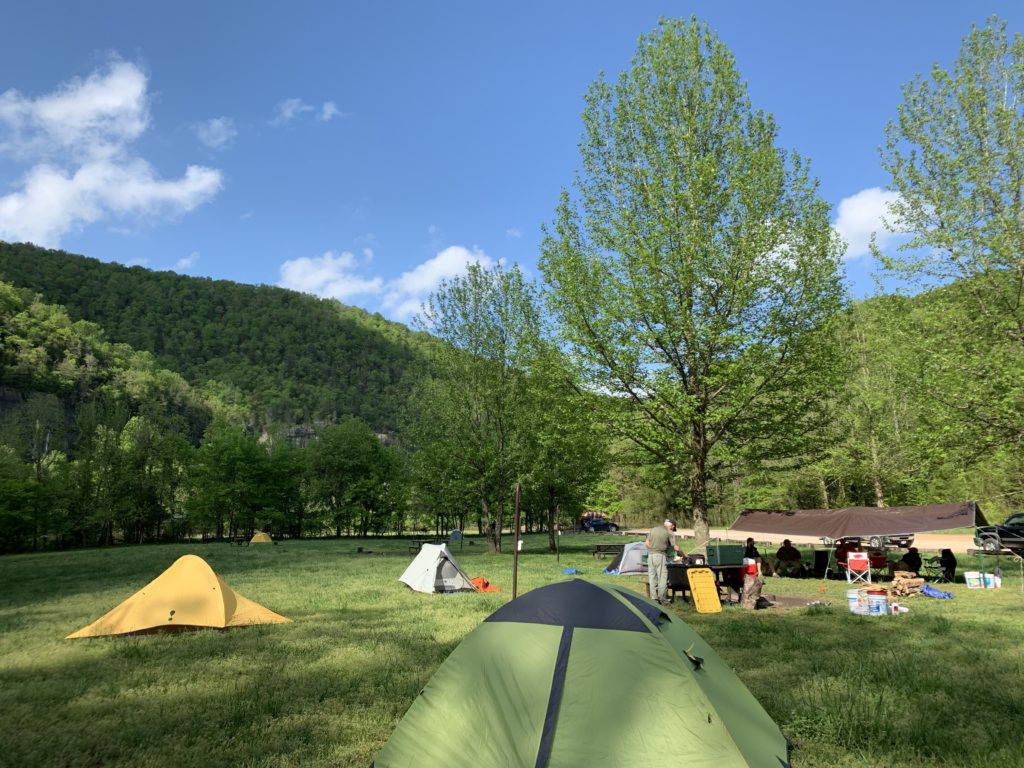
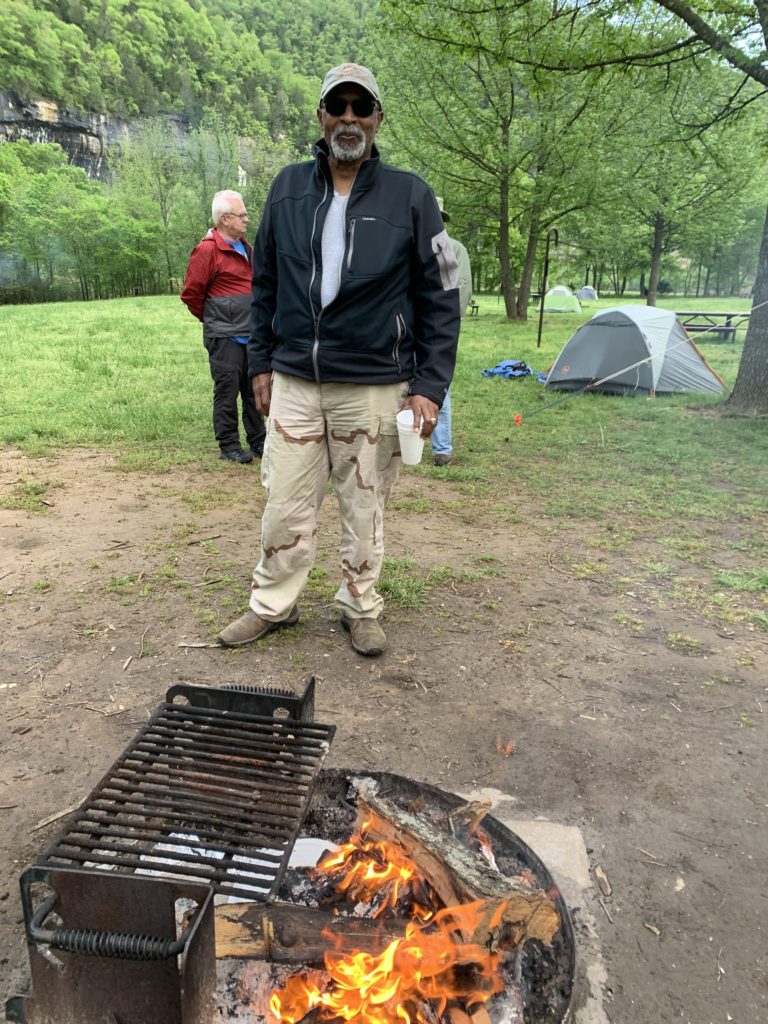
Canoeing the Buffalo River with Friends Spring 2019
In one sense it sounds right. And I’m sure there is some merit to it, in the sense of focus. One must stay focused on the most important target if he or she is to have any chance of hitting it.
But even the phrases “finishing strong” or “finishing well” seem for me today in some early morning moments of clarity to bely pride in me. Like I can do something significant for the Lord, or that He needs me.
Let’s be clear, and honest. He doesn’t.
Now He may want something from us, or enjoy it when we are walking in truth and healthy relationships. We’ll perhaps get to that later or another time. But He doesn’t need us. He tells us many times in Scripture He’s quite Self sufficient, Other from His creation and created beings, Whole and happy and content within Himself.
Several verses of Scripture and thoughts flood my mind to support those thoughts. But at the top of the list is Isaiah 66:1-2.
“Thus says the Lord: “Heaven is My throne, And earth is My footstool. Where is the house that you will build Me? And where is the place of My rest? For all those things My hand has made, and all those things exist,” Says the Lord. “But on this one will I look: on him who is poor and of a contrite spirit, and who trembles at My word.” (Isaiah 66:1–2, NKJV)
These are among the last words recorded of Isaiah, perhaps the greatest Hebrew prophet, certainly the greatest writing prophet. From the last chapter of his amazing book and life in a rather dark time for Israel and Judah, 700 years before Christ and the New Testament. It was a time of idolatry, spiritual blindness and apostasy in God’s people. It was a time marked by unhealthy relationships with their God and with each other. Sound familiar or pertinent?
Sure it does! If you have any spiritual sight or senses left. If you compare the mores of our culture to those that please the Creator from His Word and those of the USA today. It’s cause for alarm, and perhaps panic, if you have any sense from human history of what follows when this situation exists in a nation or among nations.
The American way, the humanistic way, is to start trying to fix it! Let’s analyze how we got here, or maybe just analyze the problems and tackle them until we fix them. It sounds so right, and it’s who we are and what we do, isn’t it?
But this trait can also show us who we’ve become. Man trying to be like God, or believing he is like God? This is a simple definition of secular humanism, perhaps the oldest religion, originating in the garden.
“… in the day you eat of it your eyes will be opened, and you will be like God, knowing good and evil.”” (Genesis 3:5, NKJV)
Humanism is subtle and it is a part of who we are from creation. God’s people are to be humans but not secular humanist, saying “We have no need of Him,” or like a two year old, “I can do it by myself!” These are lies; substantiated in the Bible and in human history. We do need Him. It was and is always a part of His plan for us. To come to some maturity, yes, but to always need Him, trust Him, and be in relationship with Him.
We are created in His image, but we are not like Him. He is totally Other. He’s the God of all He created and we are not.
One of my favorite and most important spiritual mentors, Charles Simpson, recently said, “They tell us now there are about one hundred billion galaxies, containing about one hundred billion stars each. I don’t know who counted them? And isn’t it like human beings, we discover something, and we act like we made it. “ Telling isn’t it?
I also had the privilege and honor of visiting with Charles for a couple days recently with three other brothers, for friendship, fellowship, and spiritual counsel. In a private time with him, I mentioned this thought of “finishing strong.” He quickly said something like, “I’ve never preached a sermon on it or thought much about it.” That’s telling. About me.
And it brings me back to how I should be living, and my focus, in this chapter and maybe all chapters of my life? Not like I have to fix big cultural or church problems, or do something significant for God?
Compare the lie giving birth to secular humanism in the garden to what David said in the Psalms.
“O Lord, my heart is not proud, nor my eyes haughty; Nor do I involve myself in great matters, Or in things too difficult for me. Surely I have composed and quieted my soul; Like a weaned child rests against his mother, My soul is like a weaned child within me.” (Psalm 131:1–2, NASB95)
This was “a man after God’s own heart” who “accomplished God’s purposes in his generation.” He was also Israel’s greatest king, save One.
And that King, would say that becoming like a little child would be very important. Little children are very trusting, and learning, and humble, and know they have needs. They also know the relationship with the people who gave them life and care for them is precious and most important. So then, the way up appears down. Perhaps living life and seeing life from the height of a bended knee? Or like a little child?
“At that time the disciples came to Jesus and said, “Who then is greatest in the kingdom of heaven?” And He called a child to Himself and set him before them, and said, “Truly I say to you, unless you are converted and become like children, you will not enter the kingdom of heaven. “Whoever then humbles himself as this child, he is the greatest in the kingdom of heaven.” (Matthew 18:1–4, NASB95)